 How-to
Best Wood for Custom Bathroom Vanities: 2026 Guide
Table of Contents
- Start With Your Bathroom, Not the Wood
- Solid Wood vs. Engineered Wood for Custom Bathroom Vanities
- MDF vs. Plywood Bathroom Cabinets: What Belongs in the Box
- The Best Wood for Bathroom Cabinets: Species Compared
- Wood Finish for Bathroom Vanity: Sealing Grain, Edges, and Joints
- Cost, Care, and Long-Term Value
- Conclusion: Choosing With Confidence
- Frequently Asked Questions
Last Updated: October 12, 2026
Start With Your Bathroom, Not the Wood
The best wood for custom bathroom vanities depends less on species than on the room it lives in. A poorly ventilated hall bath is a different environment than a spacious primary bath with a window and exhaust fan.
This guide walks through how to assess the room, match the material to each vanity component, then compare species on moisture behavior, appearance, and care.
Assess Humidity, Ventilation, and Splash Zones
Bathroom vanities live in the wettest room in the house, so first measure how wet yours gets. If the mirror stays fogged for minutes after a hot shower, you have a humidity problem that will affect any cabinet material.
Three factors decide how much protection your vanity needs:
- Ventilation: A working exhaust fan that runs during and after showers keeps ambient humidity far lower.
- Splash zones: The sink surround, countertop edges, and the cabinet face directly under the sink take the most direct water contact.
- Room size and layout: Small bathrooms with no window trap moisture longer than large, open rooms.
A common mistake is choosing wood on looks alone, then discovering the room has no fan and a shower two feet from the vanity. Fix ventilation first, then pick the wood.
Match the Wood to the Vanity Component
A vanity is not one material. It's a cabinet box, doors, drawer fronts, and a frame, each facing different stress. The box holds plumbing and sits closest to the floor, where leaks land; doors and drawer fronts take daily handling.
Prioritize moisture resistance in the box and appearance on visible faces, spend where it shows, protect where it matters.
Solid Wood vs. Engineered Wood for Custom Bathroom Vanities
Solid wood is milled from a single piece of a tree; engineered wood is manufactured from fibers, particles, or veneers bonded together. Both have a place in a bathroom vanity, and the right answer usually combines them.
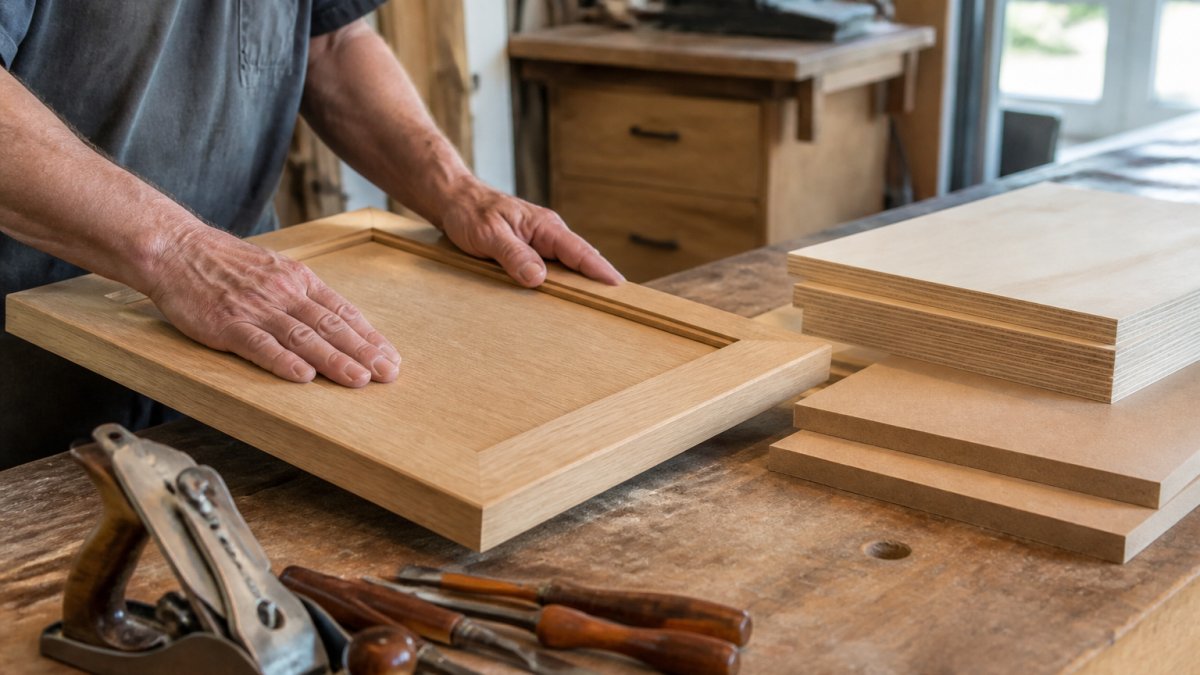
Solid wood brings unmatched grain character and can be refinished for decades, but it expands and contracts with humidity, so assembly matters as much as species.
How Wood Movement Affects Cabinet Construction
Wood movement is the seasonal swelling and shrinking of lumber as it absorbs and releases moisture, a constant cycle in a bathroom.
Good construction gives wood room to move: frame-and-panel doors, floating panels, and properly oriented grain allow expansion without damage. A cabinetmaker who understands movement builds a vanity that stays tight for years; one who ignores it builds one that fails at the joints.
MDF vs. Plywood Bathroom Cabinets: What Belongs in the Box
For the cabinet box in a bathroom, hardwood plywood is the stronger choice and MDF the weaker one, mainly because of how each handles water.
MDF (medium-density fiberboard) is fine wood fibers pressed with resin. It machines smoothly and takes paint beautifully, hence its use in painted doors.
Hardwood plywood is thin layers of wood veneer glued in alternating directions.
| Material | Water Behavior | Best Used For | Watch Out For |
|---|---|---|---|
| Hardwood plywood | Resists warping; strong when edges are sealed | Cabinet box, structural panels | Unsealed edges near leaks |
| MDF | Swells when wet; doesn't recover | Painted doors and fronts | Any exposed edge near water |
| Solid wood | Moves with humidity; needs proper joinery | Frames, doors, visible faces | Rigid assembly that traps panels |
| Wood veneer plywood | Stable core with real-wood face | Premium visible panels | Thin veneer that can lift if unsealed |
The Best Wood for Bathroom Cabinets: Species Compared
The best wood for bathroom cabinets balances moisture tolerance, hardness, and appearance, and no single species wins on all three. Match the species to how much water it will actually see, and remember two boards of the same species can behave very differently depending on cut and grade.
Read Hardness and Grain Before You Read the Name
Two numbers and one grain property do most of the work when comparing species for a wet room.
- Janka hardness measures the force needed to embed a steel ball in the wood, the standard proxy for dent and wear resistance on doors and drawer fronts. Higher is harder.
- Dimensional stability describes how much a board swells and shrinks as humidity changes. High-movement species need more careful joinery and wider clearances.
- Grain and pore structure decides how the wood takes finish and how fast water wicks in. Open-pored species drink finish and need more coats; tight-grained species seal faster.
A practical rule: pick a hard, stable species for parts you touch daily, and don't overpay for hardness on parts that never see a hand or a splash.
White Oak, Maple, Cherry, Walnut, and Birch
White oak is the default recommendation for vanities in regular use.
Cherry (commonly cited around 950 Janka) brings warmth and deepens with light exposure.
Walnut (commonly cited near 1,010 Janka) offers rich, dark grain for a statement vanity, but it's softer than oak or maple and dents more easily.
Birch is a practical, cost-effective species with clean, subtle grain and hardness near maple's.
Teak Bathroom Vanity: The Moisture-Tolerant Outlier
A teak bathroom vanity is the standout for wet environments because teak naturally resists moisture and rot better than most species. Its density and natural oils make it a genuine outlier for heavy humidity or direct splash exposure. The trade-offs are real: teak is expensive, availability varies, and its warm tone may not suit every design, but for a shower-adjacent vanity or coastal home, it's hard to beat.
Grade, Cut, and Veneer Change the Price and the Performance
Species is only half the story. The same board can be cabinet-grade or full of defects, and that gap shows up in cost and longevity.
- Grade: Clear, defect-free stock (often FAS or Select) costs more and finishes cleaner. Lower grades with knots and sapwood suit painted or hidden parts but are risky on visible, water-exposed faces.
- Cut: Quartersawn and rift-sawn stock is more dimensionally stable with straighter grain than plain-sawn, which is why it commands a premium, and why it's worth it on wide door panels in a humid room.
- Veneer vs. solid: A veneered panel gives the look of an expensive species over a stable engineered core at a fraction of solid-lumber cost. The trade-off: thin veneer can lift if an edge goes unsealed, so veneered faces need the same edge protection as any panel.
Wood Finish for Bathroom Vanity: Sealing Grain, Edges, and Joints
The wood finish for a bathroom vanity matters as much as the species, because an unsealed surface will fail no matter how good the wood is. Finish keeps water out, and every exposed surface needs it.
Pick the Right Finish System
Bathroom finishes fall into two families, and the choice affects how the vanity ages and how you maintain it.
- Film-forming finishes, catalyzed lacquer, conversion varnish, and pre-catalyzed lacquer, build a hard, durable shell. They offer the best water and cleaning-agent resistance and are standard for sprayed cabinet work, though a deep scratch or chip breaks the film and can let water reach bare wood.
- Penetrating oil finishes, tung oil and similar, soak into the grain for a softer, natural look. Easy to touch up, but they need frequent reapplication and offer less standing-water protection, a poor fit for a sink surround.
For a bathroom vanity, a sprayed film finish is the safer default: it reaches corners and edges a brush often misses and holds up better to repeated cleaning.
Build the Film Where Water Actually Lands
Finish thickness, the "film build", should follow the water, not be uniform everywhere.
- End grain soaks up water faster than face grain and drinks finish, so it needs extra coats until it stops absorbing.
- All edges of plywood and MDF panels need sealing on every face, including back and underside, an unsealed edge is where panels swell.
- Joints and seams where water can pool need finish worked into the gap, not just wiped across it.
A common pattern is finishing visible faces beautifully while leaving the interior and edges raw, the most common cause of a vanity that looks fine for two years, then swells at the base.
Sheen, Re-Coating, and Everyday Upkeep
Sheen is a design choice with a maintenance consequence: matte and satin hide dust and wipe marks, while high-gloss shows every smudge and scratch. In a bathroom, satin is usually the practical middle ground.
Plan on maintenance, not a one-time seal:
- Re-coat or touch up the finish as it wears, typically every few years in a busy bath, sooner on the sink surround and the cabinet face under the sink.
- Wipe splashes promptly rather than letting water sit, especially at the sink cutout and the base of the doors.
- Run the exhaust fan during and after showers to keep ambient humidity down.
If Water Gets In: Respond Fast
Finish buys you time, not immunity. When a leak or overflow happens, the response matters more than the finish.
- Dry the area immediately and pull drawers or doors open so air reaches the interior.
- Find the source, a supply line, a drain fitting, or a slow drip under the sink, and fix it before re-finishing anything.
- Assess the damage. Solid wood and plywood that got wet briefly can often be dried and re-sealed. Swollen MDF edges generally cannot be sanded back; the panel usually needs replacing.
Sealing every face, building extra film where water lands, and responding fast to leaks separates a vanity that lasts decades from one that fails in a few seasons. The species gets the credit; the finish does the work.
Cost, Care, and Long-Term Value
Cost and long-term value in a bathroom vanity come down to matching material to conditions rather than chasing the cheapest or most expensive option.
Care is straightforward when the material is right: wipe splashes promptly, run the exhaust fan during and after showers, re-seal or touch up the finish as it wears, and fix plumbing leaks immediately. A well-built vanity in the right species, properly sealed, can last decades.
Conclusion: Choosing With Confidence
Picking the best wood for custom bathroom vanities comes down to three moves: read the room's moisture and ventilation, split material choices between the cabinet box and visible faces, and seal every surface that can meet water.
At The Pampered Home, we build cabinetry from 100% real wood, with expert design and skilled craftsmanship and quality sprayed coatings for lasting beauty. We tailor every project to your space and your coastal aesthetic.
Frequently Asked Questions
Is teak wood good for a bathroom vanity?
Teak is one of the most moisture-tolerant species you can choose for a custom bathroom vanity. Its natural oils resist water absorption, which matters in a room with daily steam and splashes. The trade-offs are cost and availability, since teak usually runs higher than domestic species. If your heart is set on a teak bathroom vanity, pair it with a quality finish on all six sides of every panel and confirm your cabinetmaker can source stable, kiln-dried stock.
Is MDF or plywood better for a bathroom vanity?
For the cabinet box, hardwood plywood is the safer default in a bathroom. Plywood holds screws well, resists warping when edges are sealed, and tolerates the humidity swings that come with showers and baths. MDF offers a smoother surface for painted doors and takes a sprayed finish beautifully, but it swells if water reaches raw edges. A practical approach often used is plywood for the box and shelves, and MDF for painted door and drawer fronts, with every edge sealed. That combination balances moisture resistance with a flawless painted look.
Which wood holds up best to bathroom humidity?
Teak and white oak consistently rank among the best performers in bathroom settings. Teak's natural oils slow water absorption, and white oak's tight grain and density help it resist moisture when properly finished. Maple is durable and more budget-friendly, but it is less moisture-resistant, so it needs a thorough finish and good ventilation. Whichever species you choose, the finish and construction matter as much as the wood itself. Sealed edges, coated end grain, and a working exhaust fan will extend the life of any vanity.
Will a dark wood vanity look dated in a few years?
Dark wood vanities remain a strong choice when the design fits the room. Walnut and dark-stained oak bring warmth and contrast that lighter finishes cannot match, and they pair well with the coastal and traditional styles common in Lowcountry homes. The bigger risk is a finish that clashes with the rest of the bathroom rather than the shade itself. If resale matters to you, a mid-tone stain or a natural oil finish tends to age more gracefully than an extreme color. Ask your cabinetmaker for samples finished in your actual lighting before committing.
Choosing the right wood is only half the job. The other half is construction that respects how wood behaves in a wet room, and that's where careful craftsmanship shows. The Pampered Home brings expert design for bathrooms, cabinetry built from 100% real wood, and quality sprayed coatings for lasting beauty to every vanity we build. Get started with The Pampered Home and turn your bathroom into a space that stays beautiful for years.